

Web Development: Building Websites for the Future
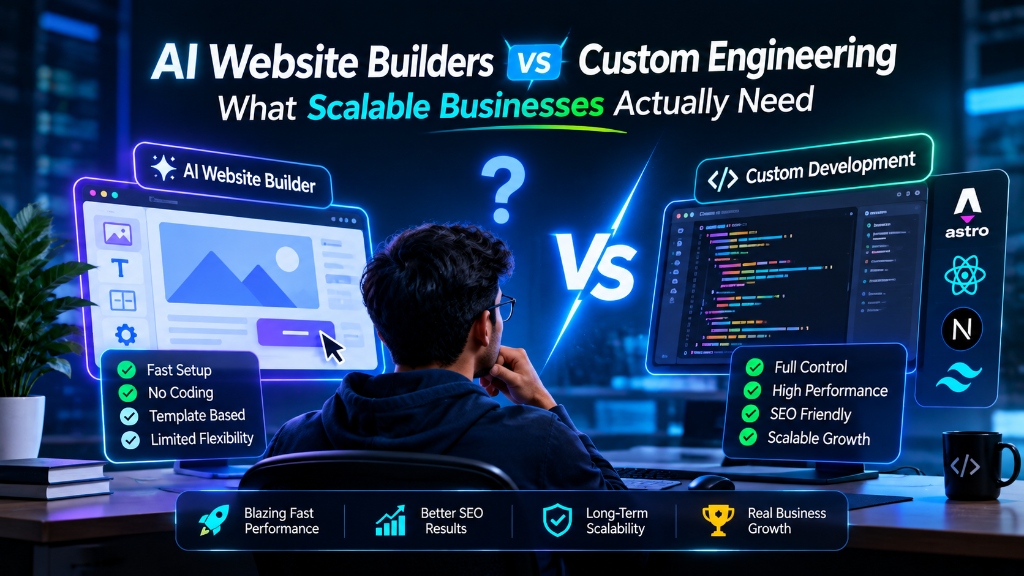
Web development is more than creating beautiful websites—it's about building powerful digital experiences. From AI-powered website builders to custom web development, technology is changing how businesses establish their online presence. However, a truly scalable website requires more than attractive design. Performance, security, responsiveness, and clean architecture are essential for long-term success. With modern frameworks and thoughtful engineering, developers can transform ideas into fast, reliable, and user-focused digital platforms. The future of web development belongs to those who combine creativity, technology, and innovation to build experiences that make a difference.
Building websites for the digital future
Web development is more than creating beautiful websites—it's about building powerful digital experiences. From AI-powered website builders to custom web development, technology is changing how businesses establish their online presence. However, a truly scalable website requires more than attractive design. Performance, security, responsiveness, and clean architecture are essential for long-term success.
With modern frameworks and thoughtful engineering, developers can transform ideas into fast, reliable, and user-focused digital platforms. The future of web development belongs to those who combine creativity, technology, and innovation to build experiences that make a difference.
The web development landscape has witnessed a surge in AI website builders promising that anyone can generate a complete, production-ready website with a single prompt. For early founders, personal hobbyists, or quick prototype validation, these tools are genuinely exciting.
However, when a company transitions from an experimental demo to a commercial business—where digital perception directly impacts sales conversions, Google SEO rankings determine customer acquisition costs, and custom databases drive operations—the limitations of AI website builders become painfully apparent.
The rapid rise of one-click website generation
Modern AI site generators operate by stitching pre-fabricated UI blocks together based on keyword matching from your prompt. In under two minutes, you receive a visually acceptable layout, stock photography, and generic marketing copy.
For validating an idea over a weekend, this is a massive upgrade over building static HTML from scratch. But speed of visual assembly must not be confused with software engineering quality.
Where AI website builders excel (and where they hit a wall)
Understanding where these tools fit in the software lifecycle prevents expensive architectural dead-ends:
- Ideal Use Cases: Personal portfolio drafts, temporary event landing pages, proof-of-concept tests, and early idea validation where performance, SEO, and custom integrations are not priorities.
- Where They Hit the Wall:
- Custom Integrations: Connecting custom webhook listeners, Meta Graph APIs, real-time WebSockets, or private databases is either impossible or heavily restricted by vendor paywalls.
- Deep Technical SEO: Automated generators struggle with nuanced canonical architectures, structured JSON-LD schemas, and precise server-side rendering routes.
- Proprietary Vendor Lock-in: You cannot export clean, maintainable source code to run on your own Docker containers or high-speed Edge CDN. If the platform increases prices or shuts down, your website disappears.
The hidden cost of architectural debt and DOM bloat
The primary architectural flaw of AI-generated websites is extreme runtime overhead. Because these tools must cater to every possible layout permutation without human code refinement, they inject massive generic JavaScript bundles and deeply nested DOM trees.
A typical AI-builder landing page often contains:
- Over 3,500 DOM elements for a simple 5-section landing page, triggering heavy browser reflows on mobile devices.
- Up to 2.8 MB of uncompressed JavaScript running client-side hydration, delaying First Contentful Paint (FCP) and ruining Core Web Vitals.
- Lighthouse mobile performance scores routinely averaging 35–55 out of 100, severely penalizing organic Google search visibility.
Why custom Astro 5 engineering delivers 10x better ROI
For businesses where website speed directly translates to revenue, custom engineering with modern frameworks like Astro 5 offers an unbeatable competitive advantage.
Astro's revolutionary Islands Architecture ships zero JavaScript by default. HTML and CSS are pre-rendered into static, blazing-fast assets. Interactive components (such as our draggable AI Assistant, magnetic cursors, or interactive filter tabs) are hydrated as isolated islands only when needed.
Architectural comparison: Benchmarks and real-world metrics
Here is an empirical comparison between a standard AI website builder deployment and our custom Astro 5 engineering stack:
| Metric | Standard AI Website Builder | Custom Astro 5 Engineering Stack |
|---|---|---|
| Lighthouse Mobile Score | 42 / 100 (Poor) | 99 - 100 / 100 (Flawless) |
| Initial JS Payload | 1.8 MB - 3.2 MB | 18 KB - 45 KB (Zero-JS baseline) |
| Largest Contentful Paint (LCP) | 3.8s (Poor rating) | 0.7s (Instantaneous) |
| Cumulative Layout Shift (CLS) | 0.18 (Noticeable jumping) | 0.000 (Zero layout thrashing) |
| Hosting & Code Ownership | Locked into proprietary hosting | 100% Full Git & Docker Ownership |
Senior Engineer Takeaway: A beautiful design that takes 4 seconds to load on mobile loses 50% of its visitors before the first headline renders. True luxury web engineering blends striking kinetic aesthetics with sub-second performance.
Frequently asked questions
Can I migrate from an AI builder to custom code later?
Most AI builders do not allow clean source code export; they either output minified, unmaintainable spaghetti code or lock your assets within their proprietary CMS. Migrating later almost always requires a complete ground-up rebuild.
Is custom web development significantly more expensive than AI builders?
Initially, an AI builder subscription seems cheaper. However, when factoring in lost conversions from slow loading times, poor SEO rankings, third-party plugin subscription costs, and eventual rebuild expenses, custom engineering yields a vastly higher return on investment over a 12-month period.
How do you achieve 100/100 Lighthouse scores with heavy animations?
By using GPU-accelerated composited transforms (
transform: translate3d), strict layout dimensions on all media assets, responsive WebP/SVG vector assets, and decoupling kinetic animations from the main UI thread via GSAP and Lenis virtual scrolling.