

RAG Architecture: Building Smarter AI Document Intelligence
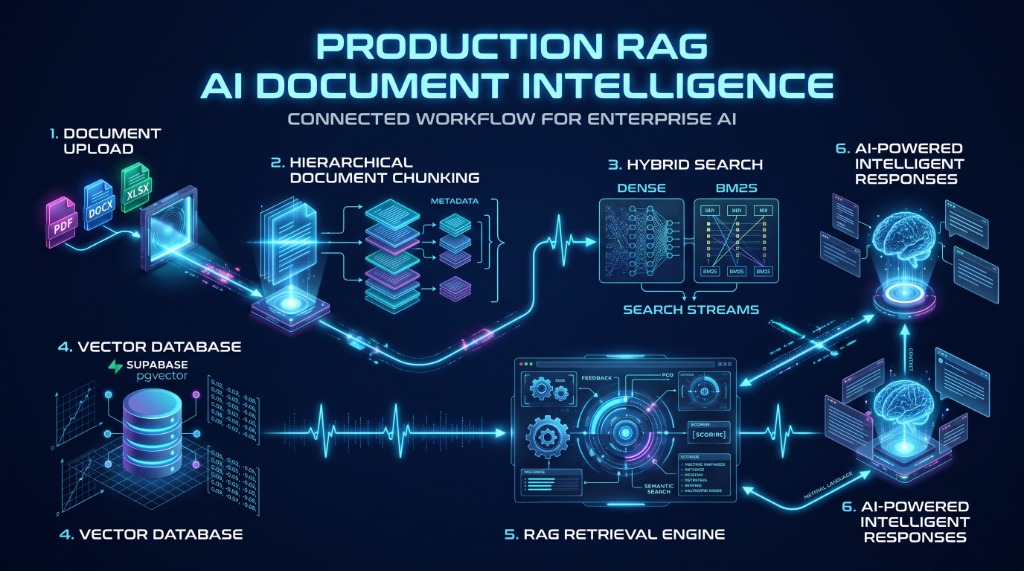
Modern software engineering is evolving with Retrieval-Augmented Generation (RAG), transforming how AI understands and retrieves information. By combining vector embeddings, semantic search, and intelligent document processing, RAG systems enable AI applications to deliver more relevant, context-aware responses. Advanced techniques such as hybrid search and optimized vector databases improve retrieval accuracy while reducing AI hallucinations. From enterprise knowledge systems to intelligent document assistants, production-ready RAG architecture is reshaping software development. The future of intelligent applications depends on building systems that don't just generate answers—they retrieve knowledge and respond with greater reliability.
The evolution of AI document intelligence
Modern software engineering is evolving with Retrieval-Augmented Generation (RAG), transforming how AI understands and retrieves information. By combining vector embeddings, semantic search, and intelligent document processing, RAG systems enable AI applications to deliver more relevant, context-aware responses.
Advanced techniques such as hybrid search and optimized vector databases improve retrieval accuracy while reducing AI hallucinations. From enterprise knowledge systems to intelligent document assistants, production-ready RAG architecture is reshaping software development. The future of intelligent applications depends on building systems that don't just generate answers—they retrieve knowledge and respond with greater reliability.
Yet in practice, over 70% of enterprise RAG deployments struggle with accuracy issues when moving beyond simple FAQ documents. They retrieve irrelevant context, misinterpret tabular financial data, and hallucinate plausible-sounding falsehoods when answering nuanced questions. Building a RAG pipeline that enterprise stakeholders can trust requires treating document intelligence as a structured data engineering problem.
Why naive RAG fails in enterprise production
Naive RAG implementations rely on arbitrary character splitting (e.g. chunk_size=1000, overlap=100). In complex enterprise documents, this naive approach fails catastrophically:
- Fractured Semantic Context: Arbitrary character cuts split crucial sentences in half, causing vector similarity to miss the core meaning of clauses.
- Loss of Tabular Cohesion: Financial tables and pricing matrices become meaningless fragments of text when split into arbitrary lines, corrupting calculation logic.
- Dense Vector Blindspots: Vector embeddings excel at semantic similarity but frequently fail at exact keyword matches (e.g., specific serial numbers, error codes, or legal contract IDs).
Document ingestion and semantic chunking strategies
To preserve meaning, document ingestion must be hierarchy-aware:
| Chunking Technique | Ideal Document Type | Key Benefit |
|---|---|---|
| Structural Markdown Splitting | Technical Documentation, Specs | Preserves header relationships (H1 -> H2 -> H3 context preservation) |
| Table-to-JSON Normalization | Financial statements, pricing sheets | Converts tables into structured key-value JSON records prior to embedding |
| Parent-Child Context Windowing | Long contracts, legal agreements | Searches small specific chunks for high similarity, but passes the larger parent context to the LLM |
Hybrid search: Combining dense vector embeddings and BM25
The single most effective architectural upgrade for production RAG is Hybrid Search. By combining dense semantic embeddings (using Google's text-embedding-004) with sparse keyword retrieval (BM25 full-text search), we achieve the best of both worlds:
-- Supabase / PostgreSQL Hybrid Search Function using pgvector
CREATE OR REPLACE FUNCTION hybrid_document_search(
    query_text TEXT,
    query_embedding vector(768),
    match_count INT,
    full_text_weight FLOAT DEFAULT 0.4,
    semantic_weight FLOAT DEFAULT 0.6
)
RETURNS TABLE (
    id UUID,
    content TEXT,
    metadata JSONB,
    combined_score FLOAT
)
LANGUAGE plpgsql
AS $$
BEGIN
    RETURN QUERY
    WITH semantic_matches AS (
        SELECT doc.id, 1 - (doc.embedding <=> query_embedding) AS score
        FROM document_chunks doc
        ORDER BY doc.embedding <=> query_embedding
        LIMIT match_count * 2
    ),
    keyword_matches AS (
        SELECT doc.id, ts_rank_cd(doc.search_vector, websearch_to_tsquery('english', query_text)) AS score
        FROM document_chunks doc
        WHERE doc.search_vector @@ websearch_to_tsquery('english', query_text)
        LIMIT match_count * 2
    )
    SELECT
        doc.id,
        doc.content,
        doc.metadata,
        (COALESCE(sem.score, 0) * semantic_weight) + (COALESCE(kw.score, 0) * full_text_weight) AS combined_score
    FROM document_chunks doc
    LEFT JOIN semantic_matches sem ON doc.id = sem.id
    LEFT JOIN keyword_matches kw ON doc.id = kw.id
    WHERE sem.id IS NOT NULL OR kw.id IS NOT NULL
    ORDER BY combined_score DESC
    LIMIT match_count;
END;
$$;
Cross-encoder re-ranking and hallucination guardrails
After retrieving the top 20 candidate passages via hybrid search, passing all 20 to the LLM introduces context clutter and increases latency. Instead, we introduce a fast Cross-Encoder Re-ranker (such as Cohere Rerank or BGE-Reranker).
The cross-encoder evaluates the exact semantic relationship between the user query and each candidate chunk, re-scoring and filtering the list down to the top 3 to 5 most relevant excerpts.
Senior Engineer Takeaway: Always enforce a strict Grounding Guardrail: instruct the LLM that if the retrieved context does not contain direct evidence to answer the query, it must state "Insufficient context available in documents" rather than attempting to guess.
Database architecture with Supabase pgvector and PostgreSQL
Rather than managing a separate, specialized vector database (such as Pinecone or Milvus), hosting vector embeddings directly inside PostgreSQL with the pgvector extension provides immense operational advantages:
- ACID Transaction Guarantees: Document updates, metadata modifications, and vector re-indexing happen within a single atomic database transaction.
- HNSW Index Acceleration: Hierarchical Navigable Small World (HNSW) indexing delivers sub-50 millisecond nearest-neighbor search speeds over millions of vectors.
- Unified Security & Access Controls: Row-Level Security (RLS) ensures enterprise multi-tenant users only retrieve document chunks they have explicit permission to access.
Frequently asked questions
What vector embedding model do you recommend for enterprise text?
Google's
text-embedding-004is exceptional for its balance of compact dimensional size (768 dimensions), superior semantic retrieval accuracy, and cost efficiency. For multi-lingual legal tasks,multilingual-e5-largeis also a strong choice.
How do you handle multi-page scanned PDFs with poor OCR?
We deploy multimodal vision models (Gemini 3.8 Flash Vision) directly over page images to extract structured Markdown rather than relying on noisy legacy OCR libraries. This preserves formatting, tables, and handwritten signatures flawlessly.
How fast can a production RAG system answer complex questions?
A well-architected pipeline (pgvector HNSW query + Cross-encoder re-rank + Gemini 3.8 Flash generation) streams its first token in under 650 milliseconds and completes full grounded responses in under 2 seconds.